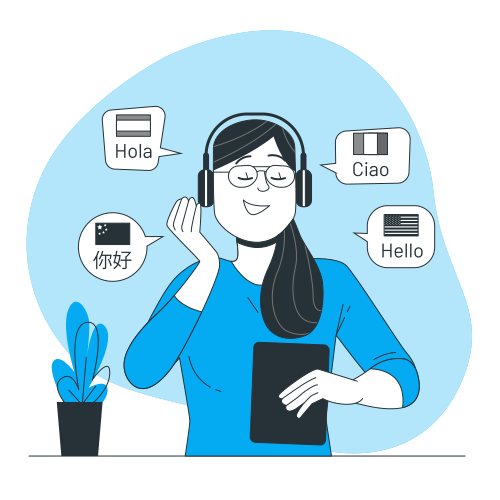
A responsible Sesap must be for its core regulation algorithms and opt-in only for data collection.
If you were to build the perfect Sesap today, what would it include? Here are the essential modules.
The data support the hypothesis that a improves efficiency and reduces perceived cognitive load. The greatest gains were observed in socially sensitive tasks (
| Domain | Representative Works | Limitations | |--------|----------------------|-------------| | | Bose Sleepbuds II (passive sound masking) Apple AirPods Pro (Siri on‑device hotword) | No continuous AI, limited context, cloud dependence | | Edge Speech Processing | Zhang et al., 2023 – “TinySpeech” (10 MOPS RNN) Wu & Lee, 2024 – “MobileBERT‑ASR” | Trade‑off between accuracy and latency; not integrated with sensors | | Context‑Aware HCI | Liu et al., 2022 – “Audio‑Scene‑aware Assistants” Patel et al., 2025 – “Physio‑Driven UI” | Primarily research prototypes; privacy‑focused designs missing | | Companion AI | OpenAI ChatGPT (cloud) Google Gemini (cloud) | Cloud‑centric, high latency, privacy concerns |
Traditional music has structure: verse, chorus, bridge. A Sesap breaks that. Using generative adversarial networks (GANs) trained on thousands of hours of nature recordings, classical music, and industrial noise, the Sesap creates novel textures that never repeat. This prevents the "auditory habituation" that occurs when you listen to the same lofi hip-hop beat for three hours. The sound is always familiar enough to be safe, but novel enough to keep your brain engaged.
A Sesap is a hybrid between a digital audio workstation (DAW), a therapeutic tool, and an AI personal assistant. The acronym can be broken down into its core pillars: