CD to MP3 Converter - convert MP3 to WAV
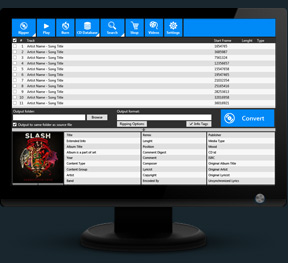
FreeRIP can "rip" selected CD tracks and convert them to MP3, WAV, Wma, Ogg Vorbis or Flac files or convert MP3 to WAV onto your hard drive.
Just put the CD in the cd drive and select from Rip menu the output format. Once you got your files, just move them to your MP3 player and go. Can't be easier!
FreeRIP is a high quality CD to MP3 converter: it allows you to fine grain set compression parameters. Anyway if you are not a digital audio expert, just leave FreeRIP MP3 encoder settings on their default and you will get high quality MP3 files with great compression rate.
Wav Converter, MP3 Converter, WMA Converter, Ogg Converter, Flac to MP3 Converter
FreeRIP MP3 Converter integrates a full featured audio file converter. Switch FreeRIP MP3 Converter to converter mode, drop the files to convert in its window, then select the output format from Rip menu and FreeRIP MP3 Converter will convert them all.
FreeRIP MP3 Converter's integrated converter can operate all the possible conversions between all the supported audio files, such like WMA to MP3, Convert MP3 to WAV, WAV to FLAC or Flac to MP3. Here follows the full list:
- WMA to MP3
- WMA to OGG
- WMA to WAV
- WMA to FLAC
- MP3 to OGG
- MP3 to WAV
- MP3 to FLAC
- MP3 to WMA
- WAV to FLAC
- WAV to MP3
- WAV to OGG
- WAV to WMA
- FLAC to MP3
- FLAC to OGG
- FLAC to WMA
- FLAC to WAV
- OGG to MP3
- OGG to WMA
- OGG to FLAC
- OGG to WAV
- Convert to MP3
- Converter MP3
- Convert MP3 to WAV
- Audio Converter
Windows provides three native ways to format a drive, ranging from simple graphical interfaces to advanced command-line utilities. How to Initialize and Format a New Hard Drive in Windows 10
Formatting a hard drive is the process of preparing the storage device for initial use or wiping it clean of all data. It effectively creates a new file system that Windows can read and write to.
Formatting erases all data on the drive. If you are formatting a drive that contains files you want to keep, back them up to an external source or cloud storage before proceeding.
This is the most straightforward method for external drives or secondary internal partitions.
Formatting a hard drive in Windows 10 is a straightforward but powerful process. By using File Explorer for simple secondary drives or Disk Management for advanced partition handling, users can prepare a drive for a new file system, erase unwanted data, or troubleshoot corruption. However, the ease of the process should never overshadow the gravity of its effect. A moment of carelessness can erase years of memories or critical work. Thus, the wise user always remembers the golden rule: back up first, format second. With that discipline, formatting becomes not a destructive act, but a constructive tool for maintaining a healthy, organized, and efficient digital workspace.
How To Format Hard Drive Windows 10
Windows provides three native ways to format a drive, ranging from simple graphical interfaces to advanced command-line utilities. How to Initialize and Format a New Hard Drive in Windows 10
Formatting a hard drive is the process of preparing the storage device for initial use or wiping it clean of all data. It effectively creates a new file system that Windows can read and write to.
Formatting erases all data on the drive. If you are formatting a drive that contains files you want to keep, back them up to an external source or cloud storage before proceeding.
This is the most straightforward method for external drives or secondary internal partitions.
Formatting a hard drive in Windows 10 is a straightforward but powerful process. By using File Explorer for simple secondary drives or Disk Management for advanced partition handling, users can prepare a drive for a new file system, erase unwanted data, or troubleshoot corruption. However, the ease of the process should never overshadow the gravity of its effect. A moment of carelessness can erase years of memories or critical work. Thus, the wise user always remembers the golden rule: back up first, format second. With that discipline, formatting becomes not a destructive act, but a constructive tool for maintaining a healthy, organized, and efficient digital workspace.